Software studio · Built solo, end to end
Software, shaped to the problem.
Configurators, wizards, web shops, sites, iPhone apps — whatever the work actually calls for. One partner, from the first sketch to the thing your customers use every day.
Start here
What do you need built?
Six shapes this work usually takes. Select one to see what it means in practice, and which projects it came out of — or take the open node, if yours isn't on the list.
Select a node · arrows to move · esc to clear
Proof
Three that show the range.
Problem, decision, outcome. The decision is the part worth reading — it's where the money is either spent well or wasted. Select one to spotlight it.
01
Strifo.Fit
iPhone app · Member & trainer
- Problem
- Members and trainers were working from two different pictures of the same training week.
- Decision
- One data model, two roles, one app — instead of two products that drift apart the moment either changes.
- Outcome
- A single native app where a trainer's change is what the member opens next.
02
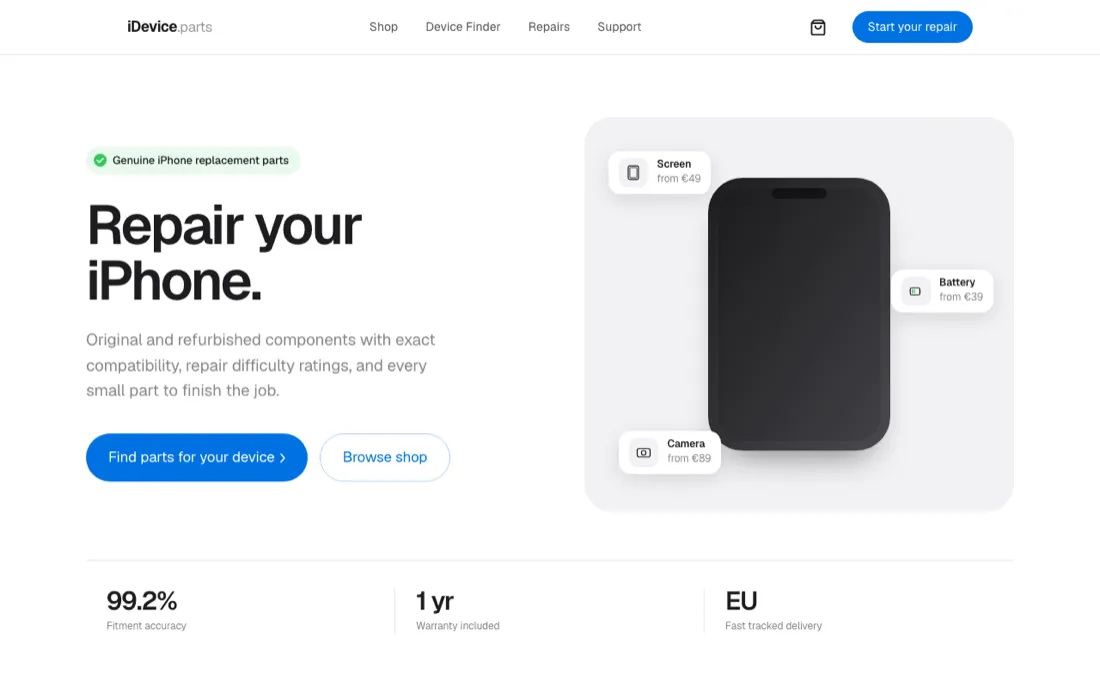 idevice.parts
iDevice.Parts
Web shop · Multi-region B2B
- Problem
- A parts catalogue with real depth was being sold through a storefront built for a much simpler business.
- Decision
- Rebuild the commerce layer around the catalogue's actual structure rather than bend the catalogue to fit a template.
- Outcome
- Trade pricing, stock and regions behave correctly without a human checking every order.
03
CORTEX.OS
Platform · Internal AI system
- Problem
- A growing set of automations with no shared spine — every new one was a new integration problem.
- Decision
- Build the spine first: one bus, one runner, one place where state lives, and treat each capability as a plug-in organ.
- Outcome
- New capability ships as an addition, not a rewrite, and three clients talk to one backend.
How it works
Four steps, in that order.
Most of what goes wrong in software goes wrong before anyone writes code. This is the part that prevents it — and the reason a one-person studio can be trusted with the whole thing.
01
Strategy
What the business actually needs to happen, stated plainly enough to disagree with.
02
Spec
The system written down before it's built. Scope, edges, and what's deliberately left out.
03
Design review
You see it and judge it while changing it is still cheap. Nothing gets built off a guess.
04
Build
First pixel to the container on the server. One person accountable for all of it.
Contact
The project scan.
Describe the problem — you get a plain-language assessment back: what it is, what it takes, and what it would cost. It's the first step of the job, and it's free.
+ Free, no obligation + Plain answers, no jargon + One builder, end to end
or write directly: rick@e-cormerce.com